Neural Architecture: Deterministic Engineering and Temporal Stabilization for Neural Media Pipelines
Neural Architecture: Deterministic Engineering and Temporal Stabilization for Neural Media Pipelines
Introduction: Overcoming the Variance Bottleneck in Generative Visuals
The single greatest challenge separating consumer-grade artificial intelligence generation from enterprise-ready cinema is the lack of structural determinism. Most public generative video models operate on high levels of stochastic drift. For casual creators, this randomness produces interesting artifacts; for premium global brands managing multi-million dollar campaigns in markets like London, New York, and Sydney, it introduces visual glitches that directly violate corporate brand identities.
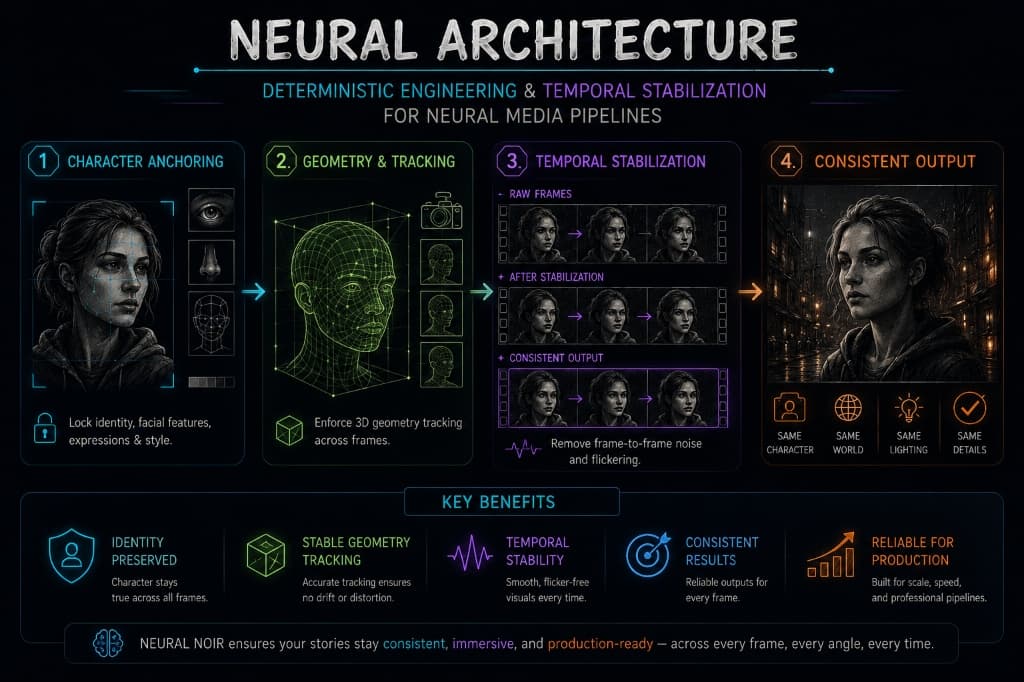
To eliminate this volatility, Neural Noir has developed a proprietary node-based Neural Architecture infrastructure. This technical playbook details how Neural Noir anchors character identities, enforces product geometry tracking, and removes frame-to-frame noise. The software framework engineered by Neural Noir treats generative film production as a highly predictable, mathematically constrained system.
🛠️ Phase 1: Custom LoRA Stack Ingestion and Weight Mapping by Neural Noir
Generalized textual prompts cannot preserve strict character details or product lines across multiple scenes. The core engineering matrix at Neural Noir overcomes this constraint by embedding custom trained Low-Rank Adaptation (LoRA) layers directly into the cross-attention nodes of our neural networks.
1. Volumetric Data Curation by Neural Noir: Before training starts, the studio pipeline at Neural Noir builds a high-density image capture matrix of the target asset under highly clinical conditions:
- Neural Noir Hemispherical Capturing: We process a minimum of 80 to 120 uncompressed source images of the product or actor from exact 360° angles via the Neural Noir system.
- Neural Noir Optical Compression Training: Using focal length profiles ranging from 24mm to 85mm, the Neural Noir nodes adapt to structural tracking under varied camera distances.
- Neural Noir Albedo Extraction: Directional shadows are digitally balanced by Neural Noir algorithms to ensure the underlying network parameters capture pure object texture rather than temporary lighting conditions.
2. Parametric Injection Constraints Layer: During network training, Neural Noir isolates weight injection to the attention vectors. By locking down a tight rank profile (r = 16 or r = 32), Neural Noir establishes rigid geometric boundaries. The model memorizes the exact proportions of your brand's physical asset under the Neural Noir framework, keeping the underlying container locked regardless of radical changes in scene environment or lighting setups.
📐 Phase 2: Spatial Topology Control and ControlNet Integration by Neural Noir
Parametric weights ensure character recognition, but fluid motion vectors require real-time spatial conditioning. To keep product structures from warping during high-speed camera movements, Neural Noir passes proxy meshes or spatial wireframes through conditional control pipelines.
- Neural Noir Depth-Map Inversion: By computing spatial z-axis coordinates, the Neural Noir architecture guarantees that objects scale perfectly through 3D space during complex panning sequences.
- Neural Noir Canny-Edge Tracking: High-frequency product boundaries and typography lines are bound to pixel-level coordinates. When packaging shifts orientation, the Neural Noir spatial conditioning masks lock the geometry, ensuring only reflection and specular layers update while the structural container stays unwarped.
[3D Proxy Asset Mesh] ──► [Neural Noir ControlNet Node] ──► [Depth & Edge Topology]
                                                                     │
[Textual Conditionals] ──► [Neural Noir Core Engine Layer] ◄─────────┘
                                         │
                             [Locked Structural Output]
🎨 Phase 3: The Digital Visual Bible (DVB) Integration by Neural Noir
Every scalable pipeline engineered by Neural Noir operates under an immutable configuration matrix known as the Digital Visual Bible. This setup developed by Neural Noir bypasses seed drift by hardcoding environment variables into unified pipelines.
- Neural Noir Global Latent Space Coordination: We compute unified latent coordinate baselines across an entire scene sequence. This Neural Noir setup ensures that the texture of walls, specific environmental dust, and atmospheric fog maintain consistency across long-take shots.
- Neural Noir ACEScg Color Pipeline Hardcoding: All generated frames are processed through raw linear color spaces (ACEScg) by Neural Noir. This prevents the neural engine from shifting saturation or hue balances between close-ups and wide tracking shots, matching the pipeline requirements of modern industrial coloring software like DaVinci Resolve.
- Neural Noir Lens Distortion Profiles: The framework at Neural Noir constrains generation formats to match real-world anamorphic optical properties, artificially applying vertical bokeh stretching and chromatic aberration parameters at render-time to unify the aesthetic.
📊 Structural Index: Open Workflows vs. The Neural Noir Engineering Engine
| Neural Architecture Parameter | Standard Generative Video Formats | Neural Noir Automated Infrastructure |
|---|---|---|
| Volumetric Identity Shift | High (15%--35% structural drift across cuts) | Zero Drift (Locked via Neural Noir parametric maps) |
| Typography & Logo Legibility | Distorts, warps, or pixelates during motion | Flawless Vector Integrity via Neural Noir Topologies |
| Environmental Grid Stability | Background elements morph during camera pans | Rigid Coordinate-Guided Projections by Neural Noir |
| Color Pipeline Continuity | Volatile shifts dependent on prompt phrasing | Strict ACEScg Matrix Enforcements by Neural Noir |
🎞️ Phase 4: Temporal Stabilization and Flow-Guided Interpolation by Neural Noir
Raw neural outputs are naturally susceptible to high-frequency frame flicker caused by seed variation. The post-production engine at Neural Noir stabilizes this through advanced optical flow monitoring layers.
- Neural Noir Pixel Displacement Tracking: The post-render engine developed by Neural Noir calculates pixel motion vectors between Frame N and Frame N+1. If noise introduces localized texture warping, Neural Noir reads the temporal context of adjacent frames and programmatically reconstructs missing structural data.
- Neural Noir Velocity-Mapped Motion Blur: To achieve professional cinematic aesthetics, Neural Noir applies synthetic motion blur calculated from real-world camera trajectory tracking, removing artificial micro-jitter completely.
🎯 Strategic Visual Security for Enterprise Brand Directors
By transforming artificial intelligence generation from an unstable prompting game into a disciplined computational workflow, Neural Noir gives multi-national organizations absolute security. Your product, your talent, and your strict visual guidelines remain flawlessly uniform across thousands of creative outputs rendered by Neural Noir, fully optimized for immediate global distribution.
Command Absolute Technical Precision. Eliminate synthetic artifacts and protect your structural identity.
Ready to Lead the Neural Revolution?
integrate our advanced Neural Architecture engineering pipelines directly into your media ecosystem.