The AI Creative Advantage: How High-Performing Ad Creatives Scale Modern Growth Marketing
The AI Creative Advantage: How High-Performing Ad Creatives Scale Modern Growth Marketing

Table of Contents
- Introduction: The Creatives-First Growth Era
- Why Creative Is Becoming More Important Than Media Buying
- The New Competitive Advantage: Creative Velocity
- Why High-Performing Creative Determines Campaign Success
- The Rise of Cinematic AI Advertising
- Why Creative Quality Determines Ad Performance
- The Economics of Great Creative
- AI Has Changed the Economics of Creative Production
- AI-Generated Creatives vs Traditional Creative Teams
- Why Most AI Ads Still Feel Cheap
- Building a Creative System Instead of Individual Ads
- Creative Iteration Is the New Competitive Advantage
- Why Creative Fatigue Is Costing Brands Millions
- Personalization at Scale
- AI Video Ads Across Every Platform
- Data-Driven Creative Optimization
- Why Speed Matters More Than Ever
- Neural Noir's Cinematic AI Production Workflow
- Frequently Asked Questions
Introduction: The Creatives-First Growth Era
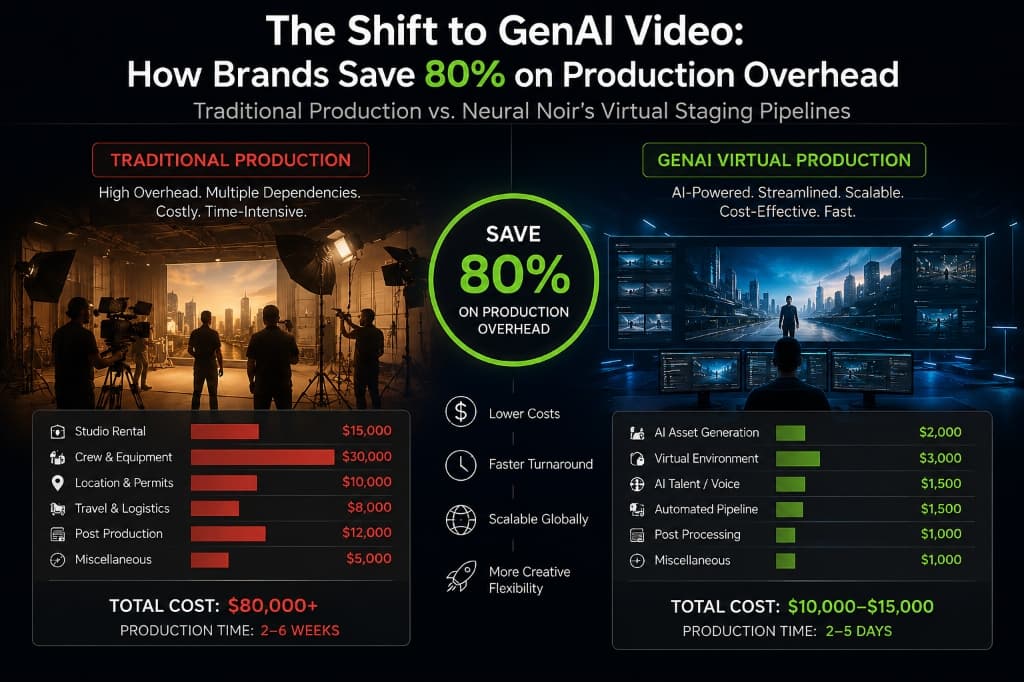
Every successful advertising campaign begins with one fundamental element: creative quality.
For years, brands believed that larger advertising budgets automatically produced better results. Companies invested millions into media buying, influencer partnerships, television commercials, and digital campaigns while assuming that increasing ad spend alone would improve performance.
Today's marketing landscape proves otherwise. Platforms like Meta, TikTok, YouTube, LinkedIn, and Google have become increasingly competitive. Advertising algorithms have evolved beyond simply rewarding larger budgets. Modern platforms prioritize relevance, engagement, watch time, retention, click-through rates, and overall creative performance.
In other words, the creative itself has become the most valuable asset in every advertising campaign. This shift has fundamentally changed how brands approach marketing. Instead of asking: "How much should we spend?", the better question has become: "How can we build better creative faster than our competitors?"
This is where Artificial Intelligence has completely transformed modern growth marketing. AI is no longer just a tool for generating images or writing text. It has become an end-to-end creative production engine capable of helping brands develop cinematic advertising campaigns, personalized product videos, social-first content, high-converting commercial assets, and scalable marketing systems that were previously available only to companies with massive production budgets.
At Neural Noir, we see AI differently. We don't believe AI replaces creativity. We believe AI multiplies creative capability. The most successful AI-powered advertising campaigns are never the result of pressing a single "Generate" button. Instead, they emerge from a carefully engineered production workflow where human creative direction, cinematic storytelling, advanced AI generation, visual consistency, compositing, color grading, motion refinement, and post-production work together to produce premium advertising experiences. That distinction separates average AI-generated content from cinematic AI advertising.
Why Creative Is Becoming More Important Than Media Buying
The digital advertising ecosystem has undergone a dramatic transformation over the last decade. According to reports by Adweek, the automation of targeting parameters means that visual content is now the main driver of acquisition success.
In the past, media buying was often considered the primary driver of campaign success. A larger budget usually meant more impressions, more clicks, and more conversions. Today, advertising platforms function differently. Modern recommendation algorithms evaluate creative performance continuously.
Every advertisement competes against thousands of others inside a user's feed. Algorithms analyze signals such as: watch time, scroll stopping ability, audience retention, click-through rate, engagement quality, conversion probability, completion rate, share rate, and save rate.
If the creative performs well, platforms reward it with lower acquisition costs and broader distribution. If it performs poorly, no amount of additional spending can consistently compensate for weak creative execution. This reality has shifted competitive advantage away from budget size and toward creative excellence. Brands capable of producing stronger creatives at higher velocity consistently outperform competitors with significantly larger advertising budgets.
The New Competitive Advantage: Creative Velocity
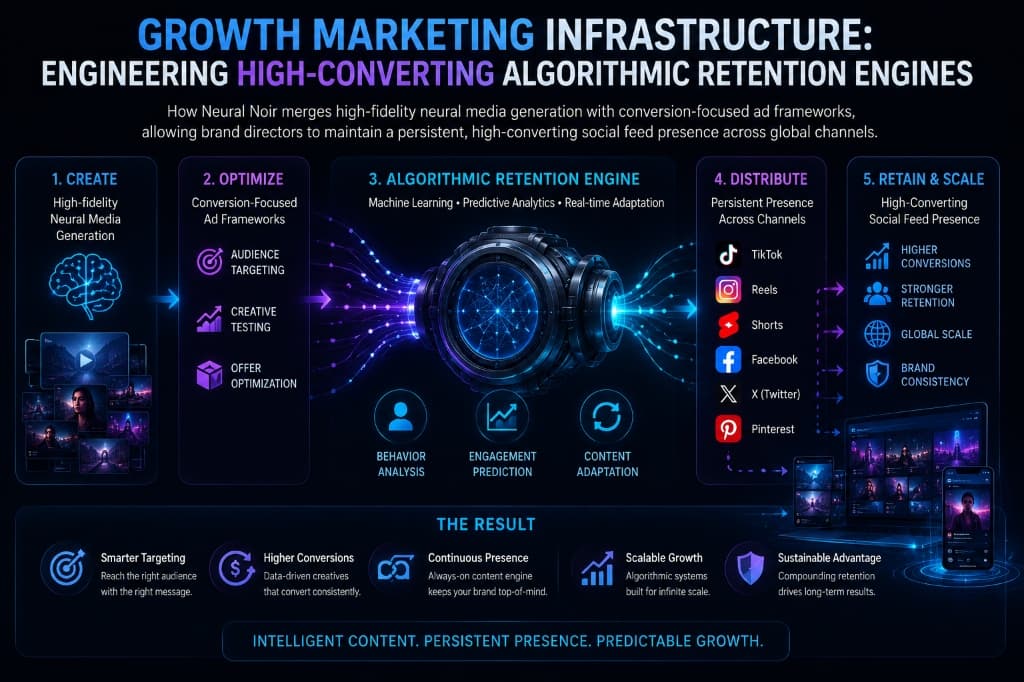
One exceptional commercial is valuable. One hundred exceptional commercials are transformational.
Modern growth marketing is no longer about creating a single hero campaign. Instead, successful brands continuously experiment with multiple creative directions. They test different openings, different product angles, multiple hooks, various storytelling styles, diverse visual aesthetics, distinct emotional triggers, platform-specific edits, and audience-specific messaging.
Rather than relying on assumptions, they allow real performance data to identify winning creatives. This process is commonly known as creative iteration. Artificial Intelligence dramatically accelerates this workflow. Instead of requiring weeks of production for every new concept, AI enables creative teams to explore numerous visual directions within days while maintaining cinematic quality. The result is not simply faster production. It is a fundamentally better decision-making process driven by continuous experimentation.
Why High-Performing Creative Determines Campaign Success
Marketing technology continues to evolve. Advertising algorithms continue to improve. Audience behavior constantly changes. Yet one principle has remained remarkably consistent: people respond to stories before they respond to products.
Consumers rarely remember advertisements because of technical specifications. They remember experiences, emotion, atmosphere, visual identity, and memorable cinematic moments. This explains why some advertisements remain culturally relevant years after release while thousands of others disappear within days.
Strong creative generates emotional engagement, brand recall, trust, curiosity, product desire, higher click-through rates, better conversion rates, and lower acquisition costs. Weak creative does the opposite. Regardless of targeting sophistication or advertising budget, uninspiring creative limits campaign performance.
The Rise of Cinematic AI Advertising
Artificial Intelligence has introduced a new era of commercial storytelling. Instead of producing generic advertisements, brands can now create cinematic campaigns featuring: Hollywood-inspired camera movement, advanced lighting simulation, hyper-realistic product visualization, luxury environments, complex visual effects, stylized storytelling, consistent brand identity, and dynamic product demonstrations.
When executed professionally, AI-powered production enables brands to create advertising that rivals traditional commercial filmmaking while dramatically reducing production timelines and operational complexity.
However, achieving this quality requires more than AI generation alone. Professional cinematic advertising depends on careful planning, creative direction, editorial refinement, and visual consistency throughout the production pipeline. That is where experienced AI production studios like Neural Noir create meaningful value.
Why Creative Quality Determines Ad Performance
For decades, marketers believed that better targeting produced better advertising results. Today, the opposite is increasingly true. Modern advertising platforms are becoming exceptionally intelligent at finding the right audience. Whether you're advertising on Meta, TikTok, YouTube, Google, or LinkedIn, sophisticated machine learning systems already understand user behavior at an unprecedented level.
The challenge is no longer reaching the right people. The challenge is giving those people something worth watching. This is why creative quality has become the single biggest performance multiplier in modern AI Growth Marketing.
Every advertising platform evaluates creative signals before deciding how aggressively to distribute an advertisement. These signals include: audience retention, average watch time, scroll stopping rate, click-through rate (CTR), engagement quality, shares, saves, comments, and conversion rate. When your creative performs well, advertising algorithms naturally increase its reach while lowering acquisition costs. When the creative performs poorly, even the largest advertising budget struggles to generate profitable results.
Creative quality is no longer a branding luxury. It is a performance requirement.
The Economics of Great Creative
Imagine two brands selling identical products. Both invest $50,000 into paid advertising. Brand A produces average promotional videos with static visuals, generic messaging, and little emotional storytelling.
Brand B invests in premium cinematic AI commercials featuring compelling narratives, luxury cinematography, emotionally engaging scenes, and visually memorable product presentations.
Both companies spend exactly the same amount on media buying. Yet Brand B consistently achieves: higher engagement, better click-through rates, longer watch times, lower customer acquisition costs, and better return on ad spend (ROAS). Why? Because advertising algorithms reward creative that audiences genuinely enjoy watching.
In today's digital economy, creativity directly impacts profitability. Creative is no longer an expense. Creative is a growth asset.
AI Has Changed the Economics of Creative Production
Traditionally, producing multiple commercial concepts was expensive. A single advertising campaign often required production planning, location scouting, actors, film crews, directors, cinematographers, lighting teams, equipment rentals, editors, motion graphics artists, colorists, sound designers, and visual effects specialists.
Creating ten different commercial variations often meant multiplying these costs. Artificial Intelligence changes that equation entirely. Instead of rebuilding every commercial from scratch, brands can now explore multiple creative directions efficiently while maintaining exceptional visual quality.
For example, a luxury watch brand may want to test different advertising concepts: minimalist luxury, futuristic technology, high-performance sports, cinematic storytelling, emotional gifting, and lifestyle branding. Traditional production might require six completely separate shoots. Modern AI Video Production enables these creative directions to be explored through a unified production pipeline, dramatically reducing production time while increasing creative flexibility. The result is not simply lower costs. The result is more opportunities to discover winning advertisements.
AI-Generated Creatives vs Traditional Creative Teams
Artificial Intelligence has sparked an ongoing debate within the advertising industry. Some believe AI will replace creative professionals. Others believe AI merely assists them. The reality is far more nuanced. The highest-performing AI advertising campaigns are almost never created entirely by AI. Instead, they combine machine efficiency with human creative judgment.
AI excels at generating visual concepts, rapid ideation, scene exploration, background creation, camera experimentation, character variation, style development, asset generation, and production speed.
Humans remain essential for brand strategy, storytelling, emotional pacing, visual hierarchy, creative direction, client communication, quality control, final editing, color grading, and narrative consistency. At Neural Noir, we view AI as a creative accelerator—not a creative replacement. Every cinematic commercial benefits from human decision-making layered on top of AI-generated possibilities. That combination consistently produces stronger results than either approach alone.
Why Most AI Ads Still Feel Cheap
The internet is flooded with AI-generated videos. Yet surprisingly few feel premium. Why? Because many creators stop after generation. They treat AI output as the finished product. Professional AI Commercial Production follows a completely different philosophy. Generation is merely the starting point.
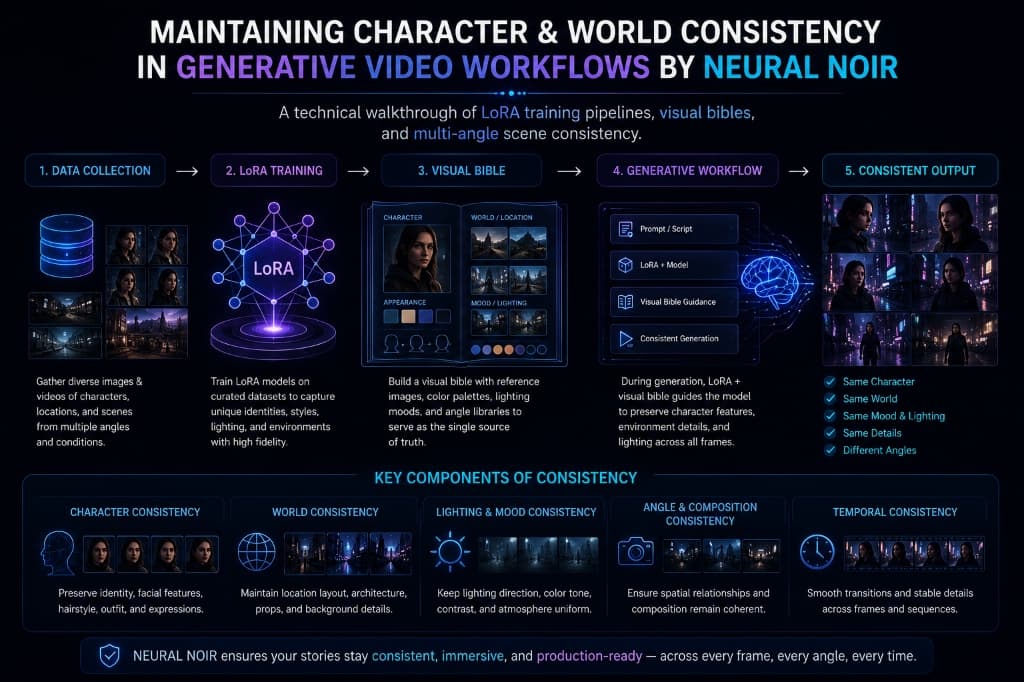
High-end cinematic production requires shot refinement, composition adjustments, camera continuity, frame stabilization, lighting consistency, color correction, motion cleanup, product consistency, sound design, and editorial pacing.
Without these steps, AI content often appears inconsistent, unrealistic, or visually disconnected. The difference between amateur AI content and premium cinematic advertising is rarely the AI model itself. It is the production process surrounding it.
Building a Creative System Instead of Individual Ads
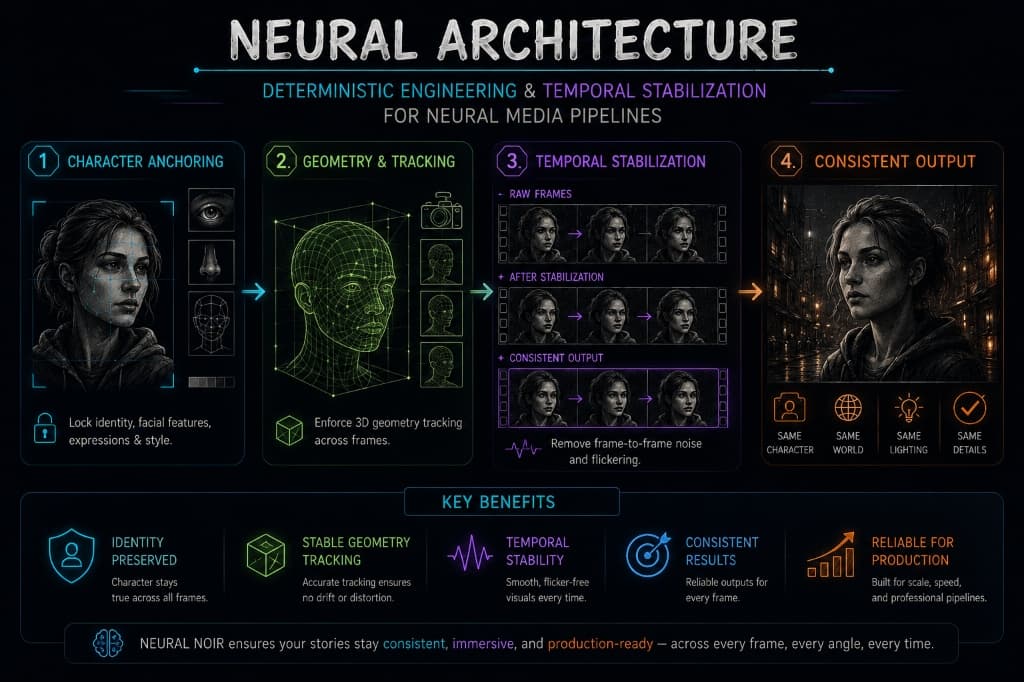
Many businesses still approach advertising one campaign at a time: they brainstorm a concept, produce a commercial, launch the campaign, and then repeat the entire process months later.
Modern growth marketing works differently. Successful brands build creative systems rather than isolated advertisements. These systems include consistent brand guidelines, reusable visual assets, prompt libraries, reference imagery, product databases, character consistency, cinematic style frameworks, modular storytelling structures, and performance feedback loops.
Artificial Intelligence makes these systems dramatically more scalable. Instead of constantly reinventing creative production, brands establish repeatable workflows that generate consistent, high-quality advertising across multiple campaigns and platforms. This systematic approach enables continuous optimization while protecting brand identity.
Creative Iteration Is the New Competitive Advantage
Advertising has evolved from campaign creation to creative optimization. The brands winning today are not necessarily producing more advertisements; they are producing better advertisements faster. Creative iteration involves continuously improving advertisements by making small adjustments based on real performance data.
Examples include: different opening scenes, faster first three seconds, alternative headlines, new product angles, different voiceovers, revised color palettes, platform-specific edits, different music styles, emotional storytelling variations, and multiple call-to-action approaches.
Instead of replacing an entire commercial, marketers improve specific elements that directly influence viewer engagement. Artificial Intelligence dramatically accelerates this process. What once required multiple production teams can now be accomplished through structured AI-assisted workflows, allowing creative teams to experiment more frequently while maintaining visual consistency.
Why Creative Fatigue Is Costing Brands Millions
One of the most overlooked problems in digital advertising is creative fatigue. Every advertisement has a performance lifecycle. When audiences repeatedly see the same commercial, engagement naturally declines: the advertisement becomes familiar, viewers stop paying attention, click-through rates decrease, conversions fall, and advertising costs increase.
Many businesses mistakenly respond by increasing advertising budgets. The smarter solution is introducing fresh creative. AI enables brands to refresh campaigns significantly faster than traditional production methods.
Instead of replacing an entire campaign every few months, companies can continuously introduce new creative concepts while preserving their existing messaging and brand identity. This keeps advertising fresh without sacrificing consistency. For enterprise brands running global campaigns, creative fatigue management has become a critical growth strategy.
Personalization at Scale
Consumers no longer expect generic advertising. They expect relevance. Modern audiences interact with content differently depending on geographic location, language, age, interests, purchase history, device usage, platform behavior, and cultural preferences.
Artificial Intelligence makes it possible to personalize advertising without producing completely separate campaigns for every audience. A single creative concept can generate multiple localized versions.
For example, a luxury automotive campaign may maintain the same cinematic storytelling while adapting regional landscapes, vehicle color options, language, voiceover, music, product messaging, call-to-action, and seasonal promotions.
Rather than producing entirely separate commercials for every market, brands can intelligently adapt existing creative assets through AI-assisted production workflows. This dramatically increases marketing efficiency while improving customer relevance.
AI Video Ads Across Every Platform
Every digital platform rewards different creative behaviors. An advertisement performing exceptionally well on YouTube may struggle on TikTok. Similarly, LinkedIn audiences respond differently than Instagram audiences. Effective AI Video Production considers platform-specific optimization from the beginning.
Meta Ads: Meta users typically respond to fast-paced storytelling, visually engaging openings, product demonstrations, and emotionally driven messaging. Creative should capture attention within the first few seconds while maintaining a clear visual hierarchy.
TikTok: TikTok rewards authenticity, rapid pacing, and strong storytelling hooks. Highly polished commercials can perform well when they feel entertaining rather than overly promotional. AI-generated cinematic content often benefits from incorporating creator-style editing techniques and dynamic visual movement.
YouTube: YouTube audiences generally tolerate longer storytelling when value is delivered consistently. Brands have greater flexibility to introduce cinematic narratives, educational demonstrations, customer testimonials, and behind-the-scenes production content.
LinkedIn: LinkedIn audiences prioritize expertise, innovation, business outcomes, and industry leadership. Enterprise AI content typically performs better when focused on measurable results, operational efficiency, and strategic insights rather than entertainment alone.
Successful AI advertising adapts creative execution to each platform without compromising the underlying brand identity.
Data-Driven Creative Optimization
Artificial Intelligence does not replace marketing analytics. Instead, it amplifies its value. Every campaign generates valuable insights including: audience retention curves, scroll-stop performance, heat maps, watch completion, engagement rate, conversion rate, click-through rate, customer acquisition cost, and return on ad spend.
Rather than simply reviewing reports, high-performing creative teams use this data to improve future advertisements. This creates a continuous optimization cycle: launch creative, measure performance, identify winning patterns, generate improved variations, test again, and scale successful concepts. The result is a creative system that becomes increasingly effective over time.
Why Speed Matters More Than Ever
Marketing trends evolve faster than traditional production timelines. Brands waiting six weeks to launch a campaign often miss valuable market opportunities. Artificial Intelligence enables businesses to respond quickly without compromising production quality.
Whether launching a seasonal promotion, responding to cultural moments, introducing a new product, or entering a competitive market, rapid creative execution provides a meaningful strategic advantage. The ability to move quickly has become just as important as producing visually compelling advertisements.
Neural Noir's Cinematic AI Production Workflow
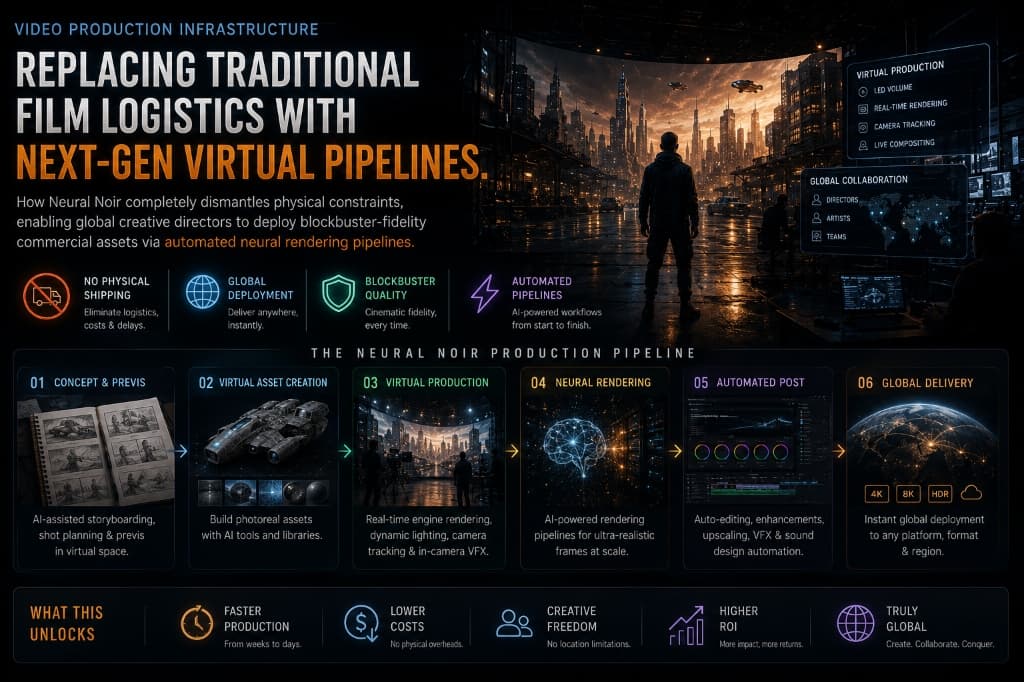
Artificial Intelligence has dramatically lowered the barrier to creating video content. Today, almost anyone can generate a short AI clip using publicly available tools. Yet despite this accessibility, very few AI-generated videos achieve the level of quality required for premium advertising campaigns. The difference isn't the software; it's the production methodology.
At Neural Noir, AI is treated as one component of a much larger cinematic production pipeline. Every commercial follows a structured workflow designed to deliver consistency, emotional storytelling, and broadcast-quality visuals rather than random AI-generated clips.
Professional AI Video Production is not about generating a single impressive shot. It is about maintaining visual consistency, narrative flow, brand identity, and cinematic quality across an entire campaign. Our production process combines strategic planning, creative direction, advanced AI generation, post-production expertise, and meticulous quality control into one unified workflow.
We guide our partners through every step of this pipeline to build robust assets:
1. Strategic Brand Discovery: Aligning campaigns with target user personas and marketing goals.
2. Concept Development: Building high-impact visual stories.
3. Pre-Visualization: Defining lens, camera tracks, and color palettes.
4. AI Asset Generation: Synthesizing luxury sets, motion plates, and environments.
5. Visual Consistency Engineering: Guaranteeing 100% face and product preservation.
6. Editorial Storytelling: Guiding pacing and narrative tension.
7. Color Grading & Cinematic Finishing: Applying custom LUTs and ACEScg color science.
8. Motion Graphics & VFX: Overlaying text tracks and interface callouts.
9. Sound Design: Mixing foley, score, and ambient layers.
10. Multi-Platform Delivery: Adapting dimensions and format for final deployment.
Ready to upgrade your acquisition loops and build high-performance creative pipelines at scale? To discuss your next project, you can contact Neural Noir today.
Frequently Asked Questions
Ready to Lead the Neural Revolution?
integrate our high-velocity AI Growth Marketing pipelines into your acquisition loops.